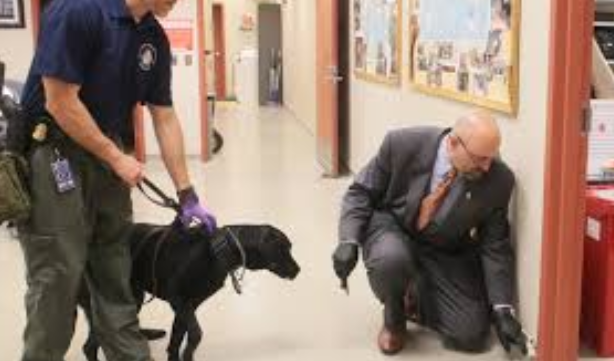
In the modern world, crime has evolved far beyond physical weapons and visible evidence. Today, some of the most critical clues in criminal investigations are hidden inside tiny digital devices—USB drives, microSD cards, smartphones, and hard disks. These devices can be concealed in walls, buried underground, or disguised inside everyday objects, making them extremely difficult for human investigators to find.
To combat this challenge, the Federal Bureau of Investigation (FBI) developed an extraordinary solution: a highly trained canine capable of detecting electronic devices by smell. That canine was Iris—a black Labrador retriever who became one of the most unique and effective “agents” in modern law enforcement.
What makes Iris even more remarkable is her resilience. After battling cancer and losing a leg, she continued to inspire millions as a three-legged hero whose legacy changed the future of digital investigations.
This is the story of FBI Special Agent Iris—the cyber-sniffing dog who revolutionized how hidden technology is discovered.
The Rise of Digital Crime
As technology advanced, so did criminal methods. Criminals began storing illegal data—such as fraud records, classified information, and illicit images—on tiny electronic devices. These devices are easy to hide and difficult to detect.
A microSD card, for example, is no larger than a fingernail. It can be hidden under carpets, inside furniture, or even within walls. Traditional search methods often fail to locate such well-concealed evidence.
Law enforcement agencies realized that without a new approach, critical evidence could be missed. This gap led to a revolutionary idea: what if dogs, already trained to detect drugs and explosives, could be trained to detect electronics?
The Birth of an Idea
The concept of an electronics detection dog originated with FBI Special Agent Jeff Calandra. While working on cybercrime cases, he noticed a recurring problem—suspects were hiding digital evidence so effectively that investigators couldn’t find it.
In one case, despite multiple searches, agents failed to locate crucial digital media. Later, hidden devices were discovered by chance, revealing the scale of the problem. This inspired Calandra to think differently.
He proposed training a dog to detect the chemical components found in electronic devices. Although the idea seemed unconventional, it was approved after extensive research and planning.
This marked the beginning of a groundbreaking experiment.
Meet Iris: The Perfect Candidate
Iris, a black Labrador retriever, was selected for this ambitious project. Labradors are commonly used in law enforcement due to their intelligence, calm temperament, and strong sense of smell.
Initially, Iris was not destined for such a specialized role. She came from a training program that evaluates dogs for guide work. However, her high food motivation and sharp instincts made her an ideal candidate for detection training.
From the beginning, Iris demonstrated exceptional focus and determination—qualities essential for her future role.
Training an Electronics Detection Dog
Training Iris was unlike traditional K-9 training. Instead of detecting drugs or explosives, she had to learn to identify specific chemical compounds found in electronic devices.
Electronic components emit trace chemical signatures, even when powered off. These include substances used in circuit boards and storage devices. Iris was trained to recognize these scents through repetition and reward-based learning.
The process involved:
- Imprinting the scent of target chemicals
- Reinforcing detection through food rewards
- Conducting searches in realistic environments
- Gradually increasing difficulty levels
At first, the training faced challenges. However, through persistence and innovation, Calandra refined the method until Iris successfully learned to detect hidden electronics.
How Iris Detects Hidden Technology
Unlike humans, dogs possess an extraordinary sense of smell. They can detect odors at incredibly low concentrations—far beyond human capability.
Iris was trained to identify chemicals commonly found in:
- USB drives
- Hard drives
- Memory cards
- Smartphones
- Laptops
Even if these devices were turned off, buried, or concealed, their chemical signatures remained detectable.
When Iris located a target scent, she would signal by sitting or focusing on the spot. This behavior allowed investigators to pinpoint hidden evidence quickly and accurately.
Her abilities extended to finding devices hidden in:
- Walls
- Vehicles
- Furniture
- Outdoor environments
This made her an invaluable asset in complex investigations.
Real-World Impact: Solving Crimes
Iris’s skills were not just theoretical—they had real-world impact. One of her earliest major contributions came during the investigation of the 2016 Chelsea bombing.
While searching a suspect’s property, Iris detected a buried cellphone used in testing explosives. This evidence played a critical role in the case.
Throughout her career, Iris assisted in a wide range of investigations, including:
- Counterterrorism operations
- Child exploitation cases
- Fraud and cybercrime
- Counterintelligence missions
She conducted hundreds of searches annually and helped uncover nearly 20,000 pieces of hidden electronic evidence.
Her contributions significantly improved the success rate of investigations involving digital evidence.
A Life on the Frontlines
Iris’s job was demanding and often dangerous. She traveled extensively across the United States and even internationally, assisting multiple agencies.
Her work environments included:
- Crime scenes
- Government facilities
- Residential properties
- Outdoor search areas
She faced numerous risks, including exposure to hazardous materials and physical hazards. In one instance, she was even electrocuted during a search.
Despite these challenges, Iris continued to perform at an exceptional level, demonstrating resilience and dedication.
The Bond Between Handler and Dog
The partnership between Iris and her handler, Jeff Calandra, was central to her success. Their relationship went beyond professional collaboration—it was built on trust, discipline, and mutual understanding.
Iris’s training was based on a food reward system. She worked to earn her meals, which reinforced her motivation and focus.
Their daily routine involved:
- Continuous training
- Frequent travel
- High-pressure investigations
Iris lived with Calandra and his family, becoming more than just a working dog—she was part of the household.
The Battle with Cancer
After years of service, Iris faced her greatest challenge—cancer. She was diagnosed with a serious condition that required immediate medical intervention.
To stop the spread of the disease, veterinarians performed surgery to remove one of her front legs.
Despite this life-changing procedure, Iris showed incredible strength and adaptability. She learned to move and function with three legs, embodying resilience and determination.
The 3-Legged Hero
Iris’s transformation into a three-legged dog did not diminish her legacy—instead, it amplified it. She became a symbol of courage, inspiring both law enforcement professionals and the public.
Her story highlighted:
- The resilience of working animals
- The emotional bond between humans and dogs
- The importance of innovation in law enforcement
Even after retirement, Iris continued to receive admiration and recognition for her contributions.
Retirement and Legacy
Iris officially retired after an extraordinary career. Her retirement marked the end of an era but also the beginning of a new chapter in law enforcement.
Her work led to the development of formal training programs for electronics detection dogs.
Today, her legacy lives on through:
- New generations of cyber-detection K-9 units
- Improved investigative techniques
- Greater awareness of digital evidence
Iris proved that dogs could play a critical role in modern, technology-driven investigations.
Why Iris Matters in the Digital Age
In an era where data is one of the most valuable assets, the ability to locate hidden digital evidence is crucial.
Iris’s work demonstrated that:
- Technology alone is not enough to solve crimes
- Biological abilities, like a dog’s sense of smell, remain unmatched
- Innovation often comes from combining old and new methods
Her success bridged the gap between traditional policing and modern cybercrime investigation.
The Science Behind the Sniff
The science behind Iris’s abilities lies in chemistry and biology. Electronic devices contain compounds that emit microscopic odor particles.
Dogs can detect these particles because:
- They have up to 300 million scent receptors
- Their brains are highly specialized for odor analysis
- They can distinguish between complex chemical signatures
This combination allows dogs like Iris to perform tasks that machines cannot replicate with the same efficiency.
Challenges and Limitations
While Iris’s abilities were groundbreaking, there were challenges:
- Training is time-consuming and expensive
- Only a few dogs possess the required traits
- Continuous practice is essential to maintain accuracy
Despite these limitations, the benefits far outweigh the challenges.
The Future of Electronics Detection Dogs
Inspired by Iris, law enforcement agencies are expanding the use of electronics detection dogs.
Future developments may include:
- Advanced training techniques
- Integration with digital forensics
- Deployment in international operations
These advancements will further enhance the ability to combat cybercrime.
Conclusion: A True Pioneer
FBI Special Agent Iris was more than just a dog—she was a pioneer who changed the landscape of criminal investigations.
Her journey—from a trainee Labrador to a three-legged hero—demonstrates the power of innovation, resilience, and partnership.
In a world increasingly dominated by technology, Iris proved that sometimes, the most advanced tool is still a loyal dog with an extraordinary nose.